Case Studies

Gaps nobody had priced, and what we built to fill them.

Each engagement below started the same way: someone was about to pay for the obvious answer, and the obvious answer did not solve the problem. We define what the answer has to be, build the thing that produces it, and show where it breaks. The method behind the work is in six short research notes, starting with why the records come first.

Eight engagements, one founder on each: a lender package built from a race team's own books, a race team turned into a hospital recruiting tool, a statewide farmland acquisition platform, a consumer brand built and sold, a software product for a service business, a paddock turned into a market, deal diligence rooms, and an operating cadence that runs itself. Finance, data, product, operations and people, with the result and the failure modes written up for each.

Case study

How Mapping the Paddock as a Market Made a Race Program Sustainable

A usable profile of every participant in the paddock, and three tools built on it: deals between the businesses already inside, outside businesses brought in, and teams finding their next driver and partner. Created for one program, now licensed to others.

At a glance

A race program heading into the Indy 500 depended on sponsorship, which is logo money: it does not cover a season and is sold again from zero every year. We treated the paddock as what it is, a room full of owners, executives and suppliers, and started with the data. For every participant we backed into net worth from run cost and public records, and added prior business dealings, personality, history and schools, until each seat had a full and usable profile behind it. That dataset has value on its own. On it we built three tools. The first brokers deals between the businesses already inside the paddock and the series' own partners: a tire sponsor, two drivers' fathers, one fleet deal, savings split back into racing. The second maps the outside companies with a reason to be in that room this year, gates and scores them, and works them through a sales engine that cannot send a wrong email. The third lets teams find talent, and their next partners and drivers, from the same profiles. Nobody had used this white space. We created it for one program and licensed it to others.

Service lines
Asset & Paddock Monetization
Business Development
Corporate Partnerships
Venture & NewCo Development
Sector
Motorsports, IndyCar and IMSA
Client
A race program in IndyCar and IMSA (not named); licensed since to other programs
Engagement
July to October 2026
Confidentiality
The client is not named. The numbers are real.
Code
github.com/anader298/pit-wall: the guardrails and tools, runnable on synthetic data
Challenge

Logo Money Does Not Fund a Season

Partnership revenue for a race program is usually sponsorship: a brand pays for a decal and hospitality, measures impressions, and decides each winter whether to do it again. The money is real but it is thin, it rarely renews on its own, and the sales effort starts over every year. Agencies sell the exposure. Lead-list vendors sell names at companies. Neither sells the room.

Exhibit 1What a logo sells, and what a trading partner sells
A partner that tradesFor example, the series tire sponsor in the fleet deal below
What is sold
Introductions to the businesses already in the paddock
What the partner gets
Deals inside the paddock, and more volume on its books
Who else gains
The families: savings split back into racing, seats funded, new customers
Renewal
Renews because the partner made money
Margin to the program
Expands. The profiles are built once; every new deal, partner and license runs on them, so the same work is sold more than once.
Margin expansion comes from what the program sells, not from a bigger fee. The sportsbook is an illustration of a logo partner, not this program's sponsor. No fees or amounts are disclosed.

Two questions had the same shape and nobody had answered either:

  • Which companies would pay to be in the paddock, and could sign without a committee?
  • Which drivers could fund a seat? That means: who is the money behind each driver, and how do you reach them professionally without going through the team they currently drive for?
The white space

The Paddock Was Already Full of Money. Nobody Had Mapped It.

  • Behind most seats is a business. A family company with published revenue, a founder, a registry entry. It pays for the car. It also buys and sells things, and it is standing in the same paddock as two hundred other businesses for three days. Nobody had treated that as a market. The families already trust each other; they had simply never been introduced as businesses.
  • The profile is the asset. Net worth backed into from what a seat costs, prior dealings, personality, history, schools, for every participant in the sport. Build it once and three different businesses can run on it: inside deals, outside partners, and a team's next driver.
  • The companies trying to enter the US need a stage and a room. Dealer recruitment, distributor signings, a brand relaunch in front of qualified buyers. A race weekend is that venue. The offer is a partnership and an introduction, never a sponsorship and never a deck.
  • Four conditions decide whether a company can buy, and they multiply. One person can decide alone, a budget line already exists, there is a US surface to use what the car offers, and there is a reason this year. Every scoring list we saw added them, which is how a billion-dollar company with no marketing budget outranks a consumer brand that spends on exactly this.
  • One wrong email costs more than the campaign earns. A wrong name, a team name in a cold touch, or an unsourced audience figure in front of a CMO. So the system is built to refuse to produce one.
Three tools

One Set of Profiles, Three Businesses on Top of It

01

Inside deals

Brokers deals between the businesses already inside the paddock and the series' own partners.

TIRE SPONSOR GROWER TRUCKER TWO PROGRAMS fleet deal + volume freight savings savings

WorthOne fleet deal cut the cost of two seats and gave a series partner volume.

02

Outside partners

Maps the outside companies with a reason to be in that room this year, gates and scores them, and works them through a sales engine that cannot send a wrong email.

Fintech77
Inc. 500072
Crypto63
Gambling62
Consumer tech51
Challenger49

Decision makers in the pool, top six verticals of 14 (Exhibit 5)

WorthFour gates and a five-axis score, so the companies at the top can actually sign.

03

Teams' talent

Lets teams find talent, and their next partners and drivers, from the same profiles.

686drivers mapped
127verified family wealth
341named routes to the money
5driver lists

WorthThe same profiles, sold to teams.

Tool one, a deal from the paddock

Two Fathers, One Tire Sponsor, and Racing That Pays for More of Itself

An agricultural exporter has a son who races. So does the owner of a regional trucking company. Both fathers fund a seat from the family business. Both businesses run on tires. The series has a tire sponsor whose own sales team is measured on volume. Nobody had put the three in a room.

We did. Four parties, every one better off, and two seats cheaper to fund:

Exhibit 2The loop: one fleet deal to one company, four parties better off, two seats funded
SERIES TIRE SPONSOR wants volume on its books AGRICULTURAL EXPORTER exports across the region; son races, seat funded by the business TRUCKING COMPANY regional fleet; son races, seat funded by the business TWO RACING PROGRAMS split savings fund both seats fleet tire deal fruit moves on the fleet, better margin for both neighbors in the paddock; tires bought again every year, not once half the savings half the savings more volume, more sales
SERIES TIRE SPONSORwants volume on its books
fleet tire dealmore volume, more sales
AGRICULTURAL EXPORTERexports across the region; son races, seat funded by the business
TRUCKING COMPANYregional fleet; son races, seat funded by the business
half the savingshalf the savings
TWO RACING PROGRAMSsplit savings fund both seats
Source: a brokered deal from the engagement. Parties are described, not named. Amounts are not disclosed.

That is what makes racing sustainable: not a bigger decal, but a paddock that trades with itself. The series' partners get volume, the families get cheaper seats and new customers, and the program that made the introduction is the one they come back to.

Approach

One Dataset, Three Tools

The profiles came first, because the data is the product.

  1. Profile every participant: net worth backed in, prior dealings, personality, history, schools
  2. Tool one: broker deals between the businesses inside and the series' partners
  3. Tool two: map the outside, gate, score, ladder the contacts, verified numbers only
  4. Tool two: draft, lint, review queue, draft placed in the program's mailbox
  5. Tool three: teams find talent and their next partners and drivers from the profiles
  6. License all three to other programs

The work covered:

  • 686 drivers across F4, USF2000, USF Pro 2000, USF Juniors and the full IMSA grid, with wealth source, father or principal, company revenue where published, and a professional contact route that bypasses the current team
  • A net worth backed into for each seat from the series run cost and an assumed spend share, labeled as a scenario until verified, plus prior business dealings, personality, history and schools from public sources
  • Market research by vertical and buyer archetype, re-run in waves: fintech, crypto, gambling, consumer tech, energy drinks, prediction markets, Chinese brands entering the US, online casinos
  • Company gates on authority, budget, US activation and compliance, then a five-axis score (proven sport spend, US intent, budget capacity, US viability, timing) out of fifteen
  • Identity-safe email verification: a LinkedIn match is the person, a domain plus full name is strong, a company-level match is quarantined, a pattern guess is never sent to without a human
  • Mailbox warm-up, DNS checks and bounce thresholds that set each account's daily cap to zero until it is safe

The machine that works the outside list is deliberately boring. Models suggest and write. Code decides volume, timing, and whether anything is allowed to leave. No model ever touches a mailbox, and the final send is a person pressing a button in their own Drafts folder.
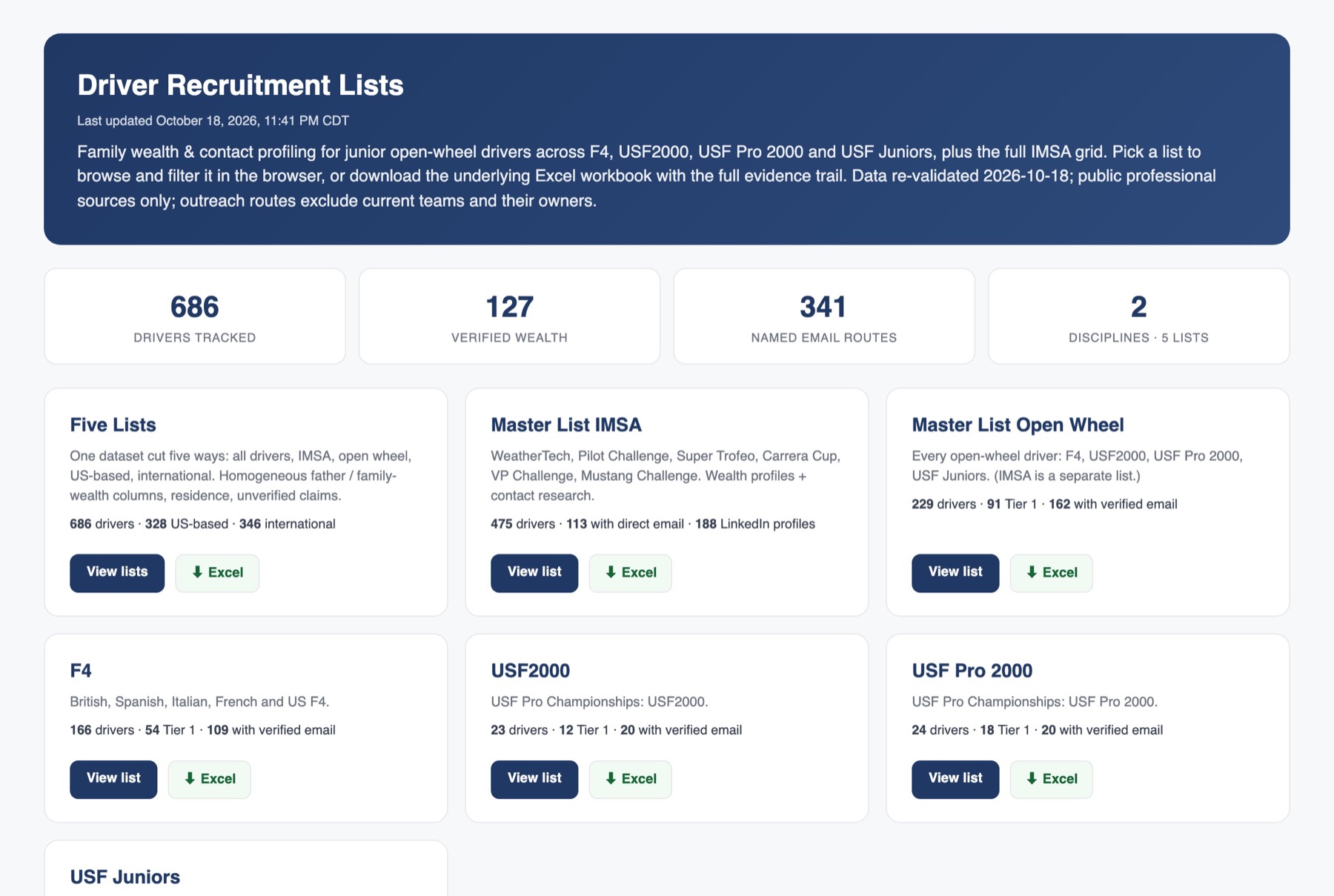
The driver recruitment lists overview page: 686 drivers tracked, 127 with verified wealth, 341 named email routes, five lists with counts and Excel downloads.
The inside map as the program sees it. The driver lists overview, counts only. The lists themselves carry names and routes and stay behind the login.
Exhibit 3The paddock as a market: who is in the room and who wants in
INSIDE THE PADDOCK 686 drivers mapped, two disciplines 127 with verified family wealth 341 named routes to the money behind a seat Family businesses that buy, sell and hire WANTS INTO THE ROOM 149 companies gated and scored 752 decision makers in the pool 476 verified sendable emails US entry, dealer recruitment, VIP hosting THE RACE PROGRAM hosts the introductions keeps the revenue that renews Partnership and introduction, never a sponsorship deck
INSIDE THE PADDOCK
686drivers mapped, two disciplines
127with verified family wealth
341named routes to the money behind a seat
Family businesses that buy, sell and hire
THE RACE PROGRAMhosts the introductionskeeps the revenue that renews
WANTS INTO THE ROOM
149companies gated and scored
752decision makers in the pool
476verified sendable emails
US entry, dealer recruitment, VIP hosting
Partnership and introduction, never a sponsorship deck
Source: Pit Wall database and driver recruitment lists, 18 October 2026. Counts are of people and companies mapped, not of deals.
Exhibit 4The inside map: five driver lists, one dataset
ListSeriesDriversTier 1 leadsVerified email
IMSA sports carWeatherTech, Pilot Challenge, Super Trofeo, Carrera Cup, VP Challenge, Mustang Challenge475—113
F4British, Spanish, Italian, French and US F416654109
USF Pro 2000USF Pro Championships241820
USF2000USF Pro Championships231220
USF JuniorsUSF Pro Championships221218
Source: Pit Wall driver recruitment lists, re-validated 18 October 2026, public professional sources only. The IMSA list reports direct email rather than a tier. Wealth is shown as a labeled scenario (series run cost divided by an assumed share of net worth) unless verified. A driver can appear on more than one list; 686 are unique.
Exhibit 5The outside map: decision makers in the pool by vertical
Fintech and neobanking77
Inc. 5000 fast growers72
Crypto and digital assets63
Gambling and sports betting62
Consumer tech and appliances51
Challenger brands49
Ride-share, delivery, logistics47
Energy drinks and beverage41
Americana and outdoor39
E-commerce and retail38
Travel and connectivity37
Prediction markets37
Streaming and entertainment26
Airlines and aviation26
Source: Pit Wall contact pool, 9 November 2026. 752 contacts in total; 87 are on a watchlist or not yet assigned a vertical and are not shown.
Result

A Dataset the Program Owns, and Three Tools It Licenses

The engagement delivered the profiles, the first deal brokered on them, the outside map and the machine that works it, the team-side tool for talent and partners, and a review of every line of the sending path before anything left the building.

Overall impact

  • 752 decision makers at 149 companies across 14 verticals, every email identity-verified or quarantined
  • 686 drivers mapped with the business behind the seat; 127 with verified family wealth; 341 named routes to the money holder
  • Four gates and a five-axis score replace a size-sorted list, so the companies at the top can actually sign
  • Numbers that are not in a verified research item cannot reach a prospect; team and driver names cannot appear in a cold touch; a wrong name cannot be overridden by anyone
  • A fleet tire deal between two drivers' family businesses and the series tire sponsor, with the savings split back into both racing programs
  • Teams using the same profiles to find talent and their next partners and drivers, which is the third tool and the one that renews every season
  • All three tools licensed to other programs: the white space was created once and sold more than once
  • About 125 sends a day of warmed capacity across the program's own domains, with DNS, warm-up and bounce gates that set a cap to zero on their own
  • Outreach runs on the program's own schedule now, and the counts change every week, so none are published here. The map was the product. Sending is the program's decision, and every draft waits for a person.
What it replaced

A sponsorship agency retainer that sells exposure, a bought lead list of names at companies, and a winter spent re-selling the same seats from zero.

What it is worth

Revenue that can renew, because the partner made money. One brokered fleet deal that cut the cost of two seats and gave a series partner volume. A third tool that finds a team its next driver and partner from the same profiles. All three licensed to other programs, so the white space pays more than once.

What transfers to you

Any room where buyers already gather, a paddock, a members' club, a trade floor, a conference, can be mapped the same way: who is in it, who wants in, and the deals between them, with the sending risk engineered out.

Where it breaks

What the Map Does Not Know

  • The pool, not capacity, is the constraint. About a third of the sponsor pool has no verified email. Name-only matches were thrown away on purpose, because a wrong match means pitching a stranger.
  • Wealth is a scenario for most drivers. It is verified for 127 of 686. The rest show a series run cost and an assumed spend share, with the basis on hover, and say so.
  • The machine lives in two places. The daily sequencer and send detection run on a Mac; the review queue, warm-up and lists run on the web. A draft approved on one is invisible to the other until they are joined.
  • Access control is the weakest link. An independent review flagged it, and per-user logins are the next fix.
  • The number check reads figures, not words. A figure written out as words, or a small number like "12 teams", is not checked against research, so a person still reads every draft before approving it.
Key takeaways

Sell the Room, Not the Decal

Any venue where buyers already gather, a paddock, a members' club, a trade floor, is a market with no map. Map who is in it and who wants in, broker the introductions, and the revenue renews because the partner made money, not because they liked the exposure.

Asset & Paddock Monetization · Business Development
The mechanics

Profiles First, Then a Sending Path With Gates

The profiles came first: one dataset of every participant, built from public sources, with wealth labeled a scenario until it is verified. A daily sequencer and send detection run without anyone starting them, and warm-up and bounce gates set a mailbox's daily cap to zero on their own. Kept current by hand, 686 drivers and 752 decision makers, with counts that change every week, is research no sales team would keep up, which is part of why nobody had mapped the room. The review is in code: an email that is not identity-verified is quarantined, a number not in a verified research item cannot reach a prospect, and a person presses send in the program's own Drafts folder.

Exhibit 6How the outside list is worked: profiles in, gates in code, a person sends
Public sourcesrun cost, public records, prior dealings, history
One set of profilesevery participant; wealth a scenario until verified
Gated and scoredfour gates and a five-axis score; emails verified or quarantined
Drafted and checkedmodels write the prose; code decides volume, timing and what may leave
A person sendsfrom the program's own Drafts folder, on its own schedule
Source: Pit Wall database and sending path, 9 November 2026.
Methodology

Models Suggest and Write. Code Decides. A Person Sends.

  • Use and lever. Analysis inside the paddock. Commercial: who can sell to whom, each deal sized low, base and high with a five-year NPV. Demand: what each family business buys, bundled into one contract with a series partner. Supplier: a seller already in the room. Outside it, a sponsor screen.
  • Where AI helps. Models suggest companies and contacts and draft emails.
  • What code guarantees. Deal values, scores and send caps; an unsourced figure blocks a draft.
  • How we know. 33 automated tests; a pre-launch review fixed 49 of 50 findings.
  • What a person approves. The terms of every introduction, and every email; the system cannot send. Code: github.com/anader298/pit-wall.
Case study

How Asset Financing Turned Race Cars Into Collateral a Lender Would Accept

Asset financing on a class the team's banks had never lent against: a $2M revolving facility approved on race cars, with rebuilt financials and agreed-value insurance behind it

At a glance

A professional motorsports team running GT4 and Porsche Cup entries, with junior open-wheel planned, wanted to grow. Every new entry is a seat to sell, at roughly $600K to $1.2M a season and a 15 to 25 percent margin. Every seat needs a car first. The team needed capital that earns, and the banks had never lent against a race car. They saw a sport. We started with the books. They were sloppy QuickBooks exports, often just incorrect, and we reconciled and rebuilt them into statements a lender could read. Then we made the cars read as an asset class: a register with value bands by car class, agreed-value insurance terms, guidance and forecast models, and a debt model a credit officer could follow. Then we ran the lender's diligence. In September 2026 an asset-based lender approved a $2M revolving facility with the race cars as collateral. The team chose not to draw it.

Service lines
Financing & Capital Strategy
Due Diligence
Sector
Professional motorsports
Client
A professional motorsports team with three operating entities (not named)
Engagement
September 2025 to September 2026
Confidentiality
The team, the lender and the insurers are not named. The numbers are real.
Challenge

The Banks Saw a Sport. The Team Was Running a Business.

The team runs three operating entities and several programs at once. The cars are the business. A seat in a GT4 car sells for a season. So does a seat in a Cup car or a junior open-wheel car. More cars mean more seats, and more seats mean more margin. Growth meant buying cars that pay for themselves.

The banks read it another way. They saw a sport with no monthly budget, no titled and valued assets, and no signed contracts on file. The team is a new business with no corporate finance function. Its books were QuickBooks exports, sloppy and often just incorrect. Insurance cost too much and had no structure a lender could rely on. Earlier cars had been paid for with private interest-free loans. That works once. It does not fund a five-year plan.

The white space

Nobody Had Made Race Cars a Bankable Class

  • A lender cannot lend against what it cannot read. Collateral comes second. First the lender has to believe the numbers, and incorrect exports from an accounting package give it nothing to believe. Rebuilding the financials was the white space before the cars were.
  • Race cars hold value in known bands. GT4, Carrera Cup and LMP2 cars each trade in a range that dealers and insurers already quote. Nobody had written the bands down for a lender.
  • Agreed-value insurance turns a car into collateral. When the policy pays a fixed sum on a total loss, the lender knows what the collateral is worth on its worst day.
  • Statements in lender format change the conversation. A credit officer reads a balance sheet, an income statement and a coverage ratio. Hand over those and the sport drops out of the room.
  • Asset-based lenders already lend on equipment. The task was to find one willing to learn one more class, and make the learning cheap.
  • A fleet fits a captive. Hundreds of entries carry the same risks. A captive prices them on the owners' own record.
Approach

From Misstated Records to a Credit Approval

We built the package a lender asks for, in the order a lender reads it. Every figure in it traces back to a workbook the team owns.

  1. Register the fleet and set value bands
  2. Fix the insurance terms
  3. Reconcile and rebuild the financials
  4. Draft the guidance and forecast models
  5. Build the debt model
  6. Run the lender's diligence
  7. Take the approval

The work covered:

  • An asset register of every car, transporter and major piece of pit equipment, by entity, with a value band for each car class
  • Agreed-value insurance terms, so each car has a fixed value on a total loss
  • Records for three operating entities reconciled from QuickBooks exports that were sloppy and often just incorrect
  • Financial statements rebuilt from those records into lender format: balance sheet, income statement and cash flow, per entity and consolidated
  • Guidance and forecast models drafted program by program, for next season and the five years after
  • A debt model with a draw period, interest-only years, a repayment schedule and a debt service coverage ratio, run for credit cases of $1.7M, $5M and $10.5M
  • A program plan that prices every new entry as a seat: season fee, operating cost, margin and the capital it needs
  • The lender's diligence questions answered from the same files, in one pass
  • Captive insurance policies built with large firms, sized on a brief that modeled 693 entries and about $183M of asset value across IMSA, SRO, SCCA and IndyCar

The rebuild came first. Many of the exports were just incorrect, so we reconciled each entity's records and rebuilt the statements before drafting a single forecast. The guidance and forecast models sit on numbers that tie out, and the debt model sits on the forecast.

Exhibit 1The debt model a lender could read
YearPhaseDrawnBalanceInterestPrincipalDSCR
2027Draw, interest only$1,766K$1,766K$212K$0n/a
2028Draw, interest only$2,455K$4,220K$506K$0n/a
2029Draw, interest only$2,652K$6,872K$825K$0n/a
2030Draw, interest only$3,675K$10,547K$1,266K$0n/a
2031Repayment$0$10,547K$1,266K$601K4.62x
2032Repayment$0$9,946K$1,194K$673K4.62x
2033Repayment$0$9,273K$1,113K$754K4.62x
2034Repayment$0$8,519K$1,022K$844K4.62x
2035Repayment$0$7,675K$921K$946K4.62x
2036Repayment$0$6,729K$807K$1,059K4.62x
2037Repayment$0$5,670K$680K$1,186K4.62x
2038Repayment$0$4,484K$538K$1,329K4.62x
2039Repayment$0$3,155K$379K$1,488K4.62x
2040Repayment$0$1,667K$200K$1,667K4.62x
EntryFromSeason feeOperating costMarginCapital per entry
GT4, IMSA Pilot Challenge2027$1,200K$950K$250K, 21%$225K
Carrera Cup, team car2027$680K$510K$170K, 25%$0
Carrera Cup, customer car2027$600K$510K$90K, 15%$0
GT4, SRO America2027$650K$485K$165K, 25%$0
USF20002027$665K$515K$150K, 23%$175K
USF Pro 20002028$800K$600K$200K, 25%$200K
Source: the team's growth workbook, Consolidated and program tabs, high case, April 2026. Entity names removed. Balance is the year-end balance in draw years and the opening balance in repayment years. Interest uses a generic rate in the model of 12 percent over a ten-year repayment. DSCR is operating income over annual debt service of $1,867K. Customer cars earn a seat fee but are not collateral.
Exhibit 2What the collateral is worth: value bands by car class
LMP2$450K to $850K
Carrera Cup$220K to $360K
GT4$160K to $320K
Source: the asset register and the captive insurance brief, 2026. Bars show the top of each band. Bands are agreed-value ranges by class, not appraisals of single cars. LMP2 is a class from the insurance brief, not on the team's register.
Exhibit 3What the package produced
$2Mrevolving facility approved, race cars as collateral
3operating entities with statements rebuilt in lender format
4.62xdebt service coverage in the model
$1.77Mcapital need for 2027 in the model
693entries modeled for the captive insurance brief
$0drawn: $0, by the team's choice
Source: credit approval, September 2026; growth workbook, April 2026; captive insurance brief, September 2026.
Result

Approved, and Left Undrawn on Purpose

In September 2026 an asset-based lender approved a $2M revolving facility for the team, secured on the race cars. The model put the 2027 need at $1.77M, so the line covers next season's growth with room to spare. The team chose not to draw it.

Overall impact

  • A $2M revolving facility approved, secured on race cars, a class the team's banks had never lent against
  • Financials for a new, non-corporate business reconciled and rebuilt from sloppy, often incorrect QuickBooks exports into statements a lender could read, and taken through a lender's diligence
  • Guidance and forecast models drafted for every program, so the lender saw next season and the five years after
  • A fleet register with value bands and agreed-value terms that a lender and an insurer can both use
  • A debt model showing 4.62x coverage, run for three credit cases up to $10.5M
  • Captive insurance policies built with large firms, in place of cover that was overpriced and unstructured
  • The facility was approved and not drawn. That still counts. The approval is the proof that race cars are a bankable class, and the package that won it works again for the next program.
What it replaced

Walking into a bank with a sport and walking out with nothing. Books that were QuickBooks exports nobody had reconciled. Private interest-free loans to pay for each new car. Insurance that cost too much and protected nobody's balance sheet.

What it is worth

A $2M approval on a class the team's banks had never lent against. A repeatable package of register, statements and model that works for any program the team adds. Captive insurance that prices the fleet on its own record.

What transfers to you

Boats, motor homes, aircraft and heavy equipment fit the same package, as does any titled asset a bank has not learned to value. So do sponsorship receivables, once the contracts are signed and on file.

Where it breaks

What the Approval Does Not Prove

  • Approved is not drawn. The facility has not been tested by a draw, a covenant check or a bad season.
  • The principal preferred private money. Private capital came with fewer conditions. The bank line is the backstop.
  • The projections are aggressive. The high case adds programs every year to 2030. The approval sits far below it.
  • Some cars are customer-owned. They earn the team a margin but are not the team's to pledge.
  • Ownership is split across three entities. Each car has to be traced to the entity that holds title before it can secure anything.
  • One lender said yes. One approval is a proof of concept. A second lender would make it a market.
Key takeaways

If It Holds Value and Has a Title, a Lender Can Learn It

Banks say no to numbers they cannot read and assets they cannot price. Fix the books first. Then write the price down by class, insure it at an agreed value, and put the business into statements a credit officer already reads. Then the asset class stops being the objection.

Financing & Capital Strategy · Due Diligence
The mechanics

The Records Did the Work

The work here was in the records. The accounting exports of three operating entities were reconciled where they were wrong, then rebuilt into a balance sheet, income statement and cash flow per entity and consolidated. The forecast sits on numbers that tie out, and the debt model sits on the forecast, run for credit cases of $1.7M, $5M and $10.5M. The review was the lender's own: its diligence questions were answered from the same files in one pass, and every figure traces back to a workbook the team owns. The register, the statements and the model work again for any program the team adds.

Exhibit 4How the package was built: records first, then the model, then the lender's review
Accounting exportsthree operating entities, often incorrect
Reconciled and rebuiltstatements in lender format, per entity and consolidated
Forecast, then debt modelthe forecast on numbers that tie out; three credit cases
The lender's diligencequestions answered from the same files, in one pass
Approvala $2M revolving facility, left undrawn
Source: the team's growth workbook, April 2026; credit approval, September 2026.
Case study

How Fragmented Public Records Became a Platform That Finds Farmland Before It Reaches the Market

From public records alone, a private acquisition platform: every farm parcel in 81 Illinois counties mapped and valued, a shortlist of 1,026 from eight default tests, and $0 spent on data

At a glance

A private family office with farmland in southern Illinois wanted to buy neighboring ground before it was listed. The facts were public but scattered across county, state and USDA records. We assembled them into a platform that identifies, values, screens and prioritizes farmland before it reaches the market, and shows where the evidence is too thin to bid.

Service lines
Due Diligence
Procurement & Asset Sourcing
Sector
Agriculture, farmland acquisition
Client
A private family office (not named), licensing the platform
Engagement
October to November 2026
Confidentiality
The platform numbers are real; the worked parcel example is illustrative.
Code
github.com/anader298/farmland-acquisition-map: the core rules, runnable on synthetic data
Challenge

Four Questions Stand Between a Buyer and a Good Farmland Deal

Every parcel raises four questions. Who owns it, and who stands behind the LLC or trust? How much is real cropland on good soil? What is it worth on sales, soil and rent? Does it fit the portfolio?

Farmland often passes into a trust or LLC and changes hands without a listing. A buyer who waits competes on price; one who answers the four questions first reaches the owner first.

The white space

The Information Was Public. Nobody Had Assembled It Into One Decision View.

  • The advantage is assembly, not access. Parcels, the LLC registry, USDA maps, flood and wetland maps and recorded sales are all public. We catalogued 1,195 sources and paid for none.
  • Vendors charge per county or per state, cover some counties and stop at the LLC on the deed. The state's free LLC file resolves 13,425 of 20,497 farmland LLCs to named people.
  • Satellite crop history turns assessed acres into cropland. Assessed acres include woods and pasture; USDA crop and soil maps give each parcel its estimated tillable acres and soil index.
  • Three valuations beat one, and their disagreement is a signal. Comparable sales, price per soil point and capitalized rent stay separate. Where they split, the buyer looks harder.
  • Where the law says stop, the platform stops. Sites whose terms bar automated access were never fetched. Their counties show as gaps on the map.
Approach

From 5.4 Million Public Parcels to a Valued, Screened Shortlist

Every figure traces to the public source it came from.

  1. Fetch every free county parcel layer and reconcile the counts
  2. One farm rule, owners resolved across counties
  3. LLCs joined to the state registry
  4. Soil, crops, flood, weather and access on every parcel
  5. Three valuations per parcel, kept separate
  6. Map, 108-field search, 15-test scorecard

The work covered:

  • 81 county layers downloaded; in the first 22, each count matched the county's own
  • One farm rule, and 108 searchable variables across land, economics, ownership, risk and logistics
  • Owners resolved into family and control groups, each link labeled by how it was made
  • 17.45 million tillable acres, and a soil index on 528,650 parcels
  • Three valuations side by side on 517,857 of 529,213 parcels
  • A tax estimate on 367,608 parcels, with a median error of 10.8% against real bills in one county
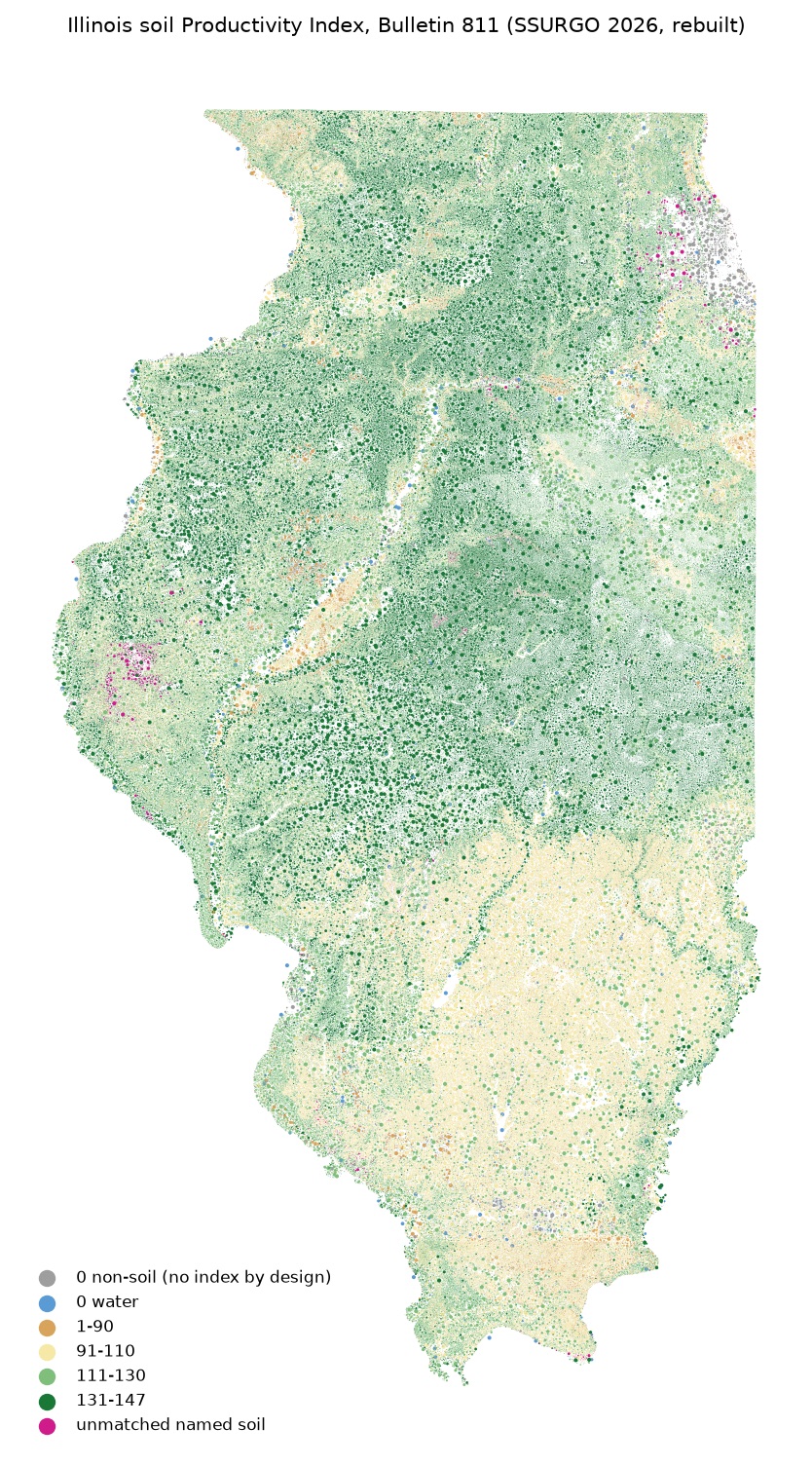
Map of Illinois colored by soil productivity index from the USDA soil survey, with a legend from 0 to 147.
One overlay: soil productivity statewide. The client's map stays private. Pink marks are soils the index could not match, shown rather than guessed.
Exhibit 1Eight free public sources, joined on every parcel, answer ownership, soil, value and risk for $0 in data
PUBLIC SOURCES, EACH FREE ONE PARCEL RECORD County parcel layers 5,423,489 parcels from 81 county endpoints $0 Secretary of State LLC file 2,136,808 manager and member rows $0 USDA Cropland Data Layer 12 years, 2014 to 2025, on 529,146 parcels $0 NRCS soil survey polygons 1,750,773 map units, rated by soil index $0 Recorded sales (PTAX-203) 56,395 farm sale declarations, 2019 on $0 Weather and crop insurance 17 measures for 102 counties; 60,293 loss lines $0 Grain markets (USDA WASDE) Monthly forecasts; corn $4.67, soybeans $12.19 $0 Grain elevators 1,059 sites; 385,010 parcels within 5 miles $0 Parcel 1 of 529,213 on the map Where and what boundary, acres, assessor class, why it is farm Who owns it owner, type, whole footprint, family group Who is behind the LLC named managers and members What it grows tillable acres, 12-year rotation How good the soil is soil index, drainage, organic matter What it is worth last sale, 5-year comps, price range, tax What can go wrong flood, wetland, heat, insured loss What it earns rent estimate; grain price outlook on a market sheet How grain gets out miles to an elevator, road frontage 108 searchable variables per parcel $0 Paid for data. Priced and declined: $6,000 for statewide parcels; $8,750 for one county's boundaries; an estimated $25,000 to $50,000 a year in licenses for 11 states.
PUBLIC SOURCES, EACH FREE
  • County parcel layers$05,423,489 parcels from 81 county endpoints
  • Secretary of State LLC file$02,136,808 manager and member rows
  • USDA Cropland Data Layer$012 years, 2014 to 2025, on 529,146 parcels
  • NRCS soil survey polygons$01,750,773 map units, rated by soil index
  • Recorded sales (PTAX-203)$056,395 farm sale declarations, 2019 on
  • Weather and crop insurance$017 measures for 102 counties; 60,293 loss lines
  • Grain markets (USDA WASDE)$0Monthly forecasts; corn $4.67, soybeans $12.19
  • Grain elevators$01,059 sites; 385,010 parcels within 5 miles
ONE PARCEL RECORD
Parcel 1 of 529,213 on the map
Where and what
boundary, acres, assessor class, why it is farm
Who owns it
owner, type, whole footprint, family group
Who is behind the LLC
named managers and members
What it grows
tillable acres, 12-year rotation
How good the soil is
soil index, drainage, organic matter
What it is worth
last sale, 5-year comps, price range, tax
What can go wrong
flood, wetland, heat, insured loss
What it earns
rent estimate; grain price outlook on a market sheet
How grain gets out
miles to an elevator, road frontage
108 searchable variables per parcel
$0
Paid for data.Priced and declined: $6,000 for statewide parcels; $8,750 for one county's boundaries; an estimated $25,000 to $50,000 a year in licenses for 11 states.
Built: six sources are joined to each parcel record, weather and insurance by county; grain prices sit on a statewide market sheet. Source: county parcel layers, IL Secretary of State LLC file, USDA CDL and soil survey, PTAX-203, WASDE; platform parcel table, 9 Nov 2026.
Exhibit 2Of 5.4 million parcels, 1,026 clear eight default tests; most good ground is priced above what its rent supports
BUILD: EVERY PARCEL KEPT, FLAGGED RATHER THAN DELETED 5,423,489 parcels downloaded from 81 county parcel layers Rule: everything the counties publish 811,511 kept in the registry Rule: a broad first pass, over-inclusive where a county's acreage was in square feet (721,245), plus 90,266 added in the 1 Nov rebuild 545,280 farm parcels Rule: assessor class, satellite crop, size; duplicates removed 529,213 on the map, 25.25 million acres Rule: 5 acres and up SCREEN: EIGHT DEFAULT TESTS, CHAINED CUT Cropland and pasture (default view) 360,050 Soil index 117 or better 231,089 -128,961 Tillable 90% or more 143,531 -87,558 Floodplain 5% or less (or no FEMA map), road frontage 123,756 -19,775 Wetland 5% or less 122,817 -939 Grain elevator within 10 miles 122,461 -356 40 acres or more 82,181 -40,280 Three price methods agree within 20% 43,944 -38,237 Rent yield 3.0% or more at that price 1,026 -42,918 (98% of what was left) Motivation score, next to land you own planned 1,026 parcels, 91,873 acres, 853 owners clear the eight chained default tests. Median rent yield on cropland and pasture where prices agree: 2.35%. Yield on its own: only 6,769 of 140,972 cropland and pasture parcels with agreeing prices (4.8%) reach 3%.
BUILD: EVERY PARCEL KEPT, FLAGGED RATHER THAN DELETED
5,423,489
parcels downloaded from 81 county parcel layersRule: everything the counties publish
811,511
kept in the registryRule: a broad first pass, over-inclusive where a county's acreage was in square feet (721,245), plus 90,266 added in the 1 Nov rebuild
545,280
farm parcelsRule: assessor class, satellite crop, size; duplicates removed
529,213
on the map, 25.25 million acresRule: 5 acres and up
SCREEN: EIGHT DEFAULT TESTS, CHAINEDCUT
Cropland and pasture (default view)360,050
Soil index 117 or better231,089-128,961
Tillable 90% or more143,531-87,558
Floodplain 5% or less (or no FEMA map), road frontage123,756-19,775
Wetland 5% or less122,817-939
Grain elevator within 10 miles122,461-356
40 acres or more82,181-40,280
Three price methods agree within 20%43,944-38,237
Rent yield 3.0% or more at that price1,026-42,918 (98% of what was left)
Motivation score, next to land you ownplanned
1,026 parcels, 91,873 acres, 853 owners clear the eight chained default tests.Median rent yield on cropland and pasture where prices agree: 2.35%.Yield on its own: only 6,769 of 140,972 cropland and pasture parcels with agreeing prices (4.8%) reach 3%.
Built versus planned: each row is a live scorecard test at its default setting, chained here. Price agreement is the condition the yield test needs. A parcel with no data on a test passes it: 41 of the 1,026 have no FEMA flood map. Motivation and adjacency are planned. Source: county parcel layers; the platform's farm rule and scorecard defaults, 9 Nov 2026.
Exhibit 3Seller signals sit on the map before a listing, but motivated sellers are not cheap: on 40+ acres, estate or trust sellers got 19% more than sales with no flag, auctions 37% more
OWNER AND SALE SIGNALS ON THE MAP, PARCELS BUILT In one of 19,129 family or control groups 143,989 Absentee: every LLC manager out of state 8,595564,752 ac, 1,919 owners Farm manager or bank trust department 4,906 Last sale (2019 on) was an auction 2,100 Owner on the deed is an estate 1,770105,036 ac Owner footprint: total acres and counties on every parcel, 208,698 owners Tax delinquent PARTIAL: lists for 9 counties on disk, not joined; one county's unpaid bills on the map Seller-signal score, 0 to 100 PLANNED: weights written, not computed FARM SALES OF 40+ ACRES, MEDIAN $ PER ACRE AGAINST SALES WITH NO FLAG ($6,000, N 3,186) -30% -20% -10% 0% +10% +20% +30% +40% Auction n 515 +37% $8,216 Estate or trust seller n 1,895 +19% $7,170 Court-ordered sale n 31 +2% $6,121 Buyer owns the land next door n 578 0% $6,000 Seller and buyer related n 1,241 -25% $4,500 PTAX-203 farm sales, 35 southern Illinois counties. What it means: estate, trust and auction sales cleared above sales with no flag, so the edge is reaching an owner first, and lawfully. A signal says where to look; only asking says whether they would sell.
OWNER AND SALE SIGNALS ON THE MAP, PARCELSBUILT
In one of 19,129 family or control groups143,989
Absentee: every LLC manager out of state8,595564,752 ac, 1,919 owners
Farm manager or bank trust department4,906
Last sale (2019 on) was an auction2,100
Owner on the deed is an estate1,770105,036 ac
Owner footprint: total acres and countieson every parcel, 208,698 owners
Tax delinquentPARTIAL: lists for 9 counties on disk, not joined; one county's unpaid bills on the map
Seller-signal score, 0 to 100PLANNED: weights written, not computed
FARM SALES OF 40+ ACRES, MEDIAN $ PER ACRE AGAINST SALES WITH NO FLAG ($6,000, N 3,186)
Auction n 515+37% $8,216
Estate or trust seller n 1,895+19% $7,170
Court-ordered sale n 31+2% $6,121
Buyer owns the land next door n 5780% $6,000
Seller and buyer related n 1,241-25% $4,500
PTAX-203 farm sales, 35 southern Illinois counties.What it means: estate, trust and auction sales cleared above sales with no flag, so the edge is reaching an owner first, and lawfully. A signal says where to look; only asking says whether they would sell.
Source: platform parcel table, 9 Nov 2026; PTAX-203 farm sales of 40+ acres; project plan (planned score).
Exhibit 4Illustrative: the $1.78M ask sits above all three values; only a neighbor's savings could close the gap
Investigate: $1.55M to $1.60M $1.50M $1.55M $1.60M $1.65M $1.70M $1.75M $1.80M $1.85M $1.90M Seller asking price $1,780,000 Comparable sales $1,760,000 Soil productivity $1,700,000 Rent capitalization $1,601,600 Adjacency premium about $240,000 Adjacency premium: $6,000 a year of verified operating savings, capitalized at 2.5%. Only a buyer next door captures it, and only if the savings are real. Without the savings, a buyer belongs in the shaded range.
Investigate: $1.55M to $1.60M
Seller asking price$1,780,000
Comparable sales$1,760,000
Soil productivity$1,700,000
Rent capitalization$1,601,600
Adjacency premiumabout $240,000
Adjacency premium: $6,000 a year of verified operating savings, capitalized at 2.5%.Only a buyer next door captures it, and only if the savings are real.Without the savings, a buyer belongs in the shaded range.
Source: Illustrative. Hypothetical parcel, not a client transaction; the methods mirror the platform's three valuations.
Exhibit 5Every parcel mapped and screened for $0 in data; where the valuations disagree, the parcel is flagged
1,026parcels that clear eight default tests
529,213farm parcels on the map, 25.25M acres, 81 counties
108searchable variables, in five layers
13,425of 20,497 farmland LLCs traced to named people
15,709recorded sales in the comparable pool
1,757parcels on the map possibly assessed above what their soils justify
34%of parcels where the three valuations agree within 20%; the rest are flagged
$0paid for data
Source: platform parcel table and data warehouse, 1 to 9 Nov 2026.
Result

A Shortlist Found From Records, Not Listings

The family office licenses a private platform that answers the four questions on one screen and grades each parcel on 15 tests whose thresholds it sets. Eight of them, chained at default settings, produce the Exhibit 2 shortlist.

Overall impact

  • Owner, footprint, soil, crops, flood, taxes and value on one screen, with a gap shown wherever a source is missing
  • LLCs traced to named people; out-of-state managers flagged
  • Next steps, not built: adjacency to the client's parcels, seller motivation and acquisition scores, ten more states
What it replaced

Per-county vendor data with patchy coverage, county research redone for every parcel, and LLC names with no people behind them.

What it is worth

A view of value before the seller sets the price: in the illustrative Exhibit 4, a $180K to $230K gap to test before any offer.

What transfers to you

Most proprietary data is public records resold at a markup. We assemble them and license you a platform you can run and audit. The method carries to any market where the facts are public and scattered.

Where it breaks

Where the Public Record Runs Out

  • Bank-held Illinois land trusts are the one owner the record cannot name. State law keeps the beneficiary off the public record. Most trust-held farmland names a trustee on the deed, so that owner is reachable.
  • Owner matching is careful, not certain. Matching on name, address and filings is not legal entity resolution. One person registered two ways can count twice.
  • Coverage is uneven. 21 of Illinois' 102 counties are not on the map yet. The 9 November figures on this page count some farm homesites as farmland; the platform corrected the rule in its 10 November rebuild.
  • The valuations screen; they do not price a bid. Comparable sales miss real prices by a median 22.6% in hold-out tests, against a 15% target, and 76 of the 80 counties tested carry a low-confidence flag shown on every parcel. The test is generous, since later sales sit in the pool and the rent value draws on the same sales, so a stricter test comes next.
Key takeaways

Find the Deal Before It Reaches the Market

Where farms change hands quietly, whoever knows the parcel, owner and value first gets the first conversation. A good platform shows its uncertainty rather than hiding it.

Due Diligence · Procurement & Asset Sourcing
The mechanics

Counted, Joined, Then Screened

Each county's parcel layer was checked against the county's own published total before anything was joined to it; in the first 22 counties every count matched. The state LLC file, USDA crop and soil maps, flood maps and recorded sales were then joined to every parcel, and a source manifest records where each field came from, so the platform is rebuilt from the public record rather than edited by hand. Screened by hand, parcel by parcel, 529,213 parcels is clerical work on a scale nobody would pay for, which is why it had not been done. Where the three valuations disagree, the parcel is flagged. Where a source is missing, the map shows a gap, not a guess.

Exhibit 6How the platform is built, checked and used: public records in, a licensed shortlist out
Sources in81 county parcel layers, the state LLC file, USDA crop and soil maps, recorded sales
Counted and joinedeach county's count checked against its own; every field traced to its source
Valued and screenedthree valuations kept separate; 15 tests, thresholds set by the client
Flagged, not guessedvaluations that disagree are flagged; a missing source shows as a gap
Licensed to the family officea shortlist of 1,026 from eight default tests
Source: the platform's build steps and source manifests; platform parcel table, 9 Nov 2026.
Methodology

Code Runs It. A Person Decides.

  • Use and lever. Screening for a buyer: 5.4 million parcels cut to owners worth approaching before land reaches market, with weakly supported prices flagged. That saves screening time and lowers the risk of overpaying.
  • Where AI helps. Only in the build. Agents found 1,195 public sources and proposed field mappings and owner-matching rules; a person reviewed each.
  • What code guarantees. Every number reruns the same. County counts match published totals, and every owner merge is logged.
  • How we know. Comparable sales miss real prices by a median 22.6% against a 15% target, so values are a screen.
  • What a person approves. Every threshold and every owner approached. Code: github.com/anader298/farmland-acquisition-map.
Case study

How a Racing Family's $100 Invitation Quote Became a Guest-List Business

A private invitation and a guest list a prominent family could put its name on, every action with a helper's name on it, and a flat-price product two sisters now sell in Beirut

At a glance

A prominent Lebanese family in racing, people we know from the paddock, was quoted $100 for a digital wedding invitation: a web page with a date on it. The page was never the problem. The list was. Four relatives on two sides of the family were sending invitations from their own phones over WhatsApp, and nobody could say who had been sent one. A family of that standing could not put its wedding on a generic, off-the-shelf, AI-generated product. The invitation had to be theirs, the data private, and nothing could fail on the night. For them it was a wedding problem and a product problem. For us it was another exercise in data management, the same discipline as the paddock maps and the farmland map, through a different lens, for people who are not data people. We added guest management: one private link per family and a helper's name on every action. Then we forked it into The Wedding Planners, flat-priced and run by two sisters in Beirut, because the problem is the same at every Lebanese wedding.

Service lines
Venture & NewCo Development
Sector
Events, Lebanon and the diaspora; motorsport families
Client
A prominent Lebanese family in motorsport (not named), then a family venture
Engagement
Spring to November 2026
Confidentiality
The family is not named. Sample data on the product page is invented.
Code
github.com/anader298/wedding-guest-platform, runnable on sample data
Challenge

The Invitation Was a Page. The Problem Was the List.

The family came to us from the paddock with a $100 quote for a page. A Lebanese wedding runs to three hundred to six hundred guests, invited family by family, mostly over WhatsApp, by whichever relatives are willing. The couple's side and the bride's mother's side keep separate lists. One aunt gets the invitation twice. A cousin abroad never gets it and finds out from Instagram. Replies arrive as "we're coming, four of us" in a chat, and never reach the sheet.

Every vendor in the market sells the page. Lebanese one-link shops at $39 to $250, Gulf platforms that charge per guest and send from a business number, American services that count every member of a family as a separate recipient. None of them lets four non-technical people send from their own phones and see, in one place, who did what and which families have gone quiet. None of them was something a family this visible could put its name on, or trust with its guest list.

The white space

For the Family It Was a Wedding. For Us It Was Data Management.

  • The same discipline, a different lens. The paddock map resolves seats to businesses. The farmland map resolves parcels to people. This one resolves a guest list to families, seats and replies, with a name on every row. The users are not data people, so it hides behind an envelope and a copy button.
  • Deliver where the guests already are. The invitation travels by copy and paste into WhatsApp, from a relative's own number. No SMS gateway and no business account. A family's phone or e-mail is kept only if a helper adds it, and never reaches the public invitation.
  • Every action carries a name. Four helpers editing one list from four phones at once was the whole design problem. Who added the family, who sent it, who reminded them: all recorded, so no aunt is asked twice.
  • The mother of the bride does not want a dashboard. She wants a spreadsheet. The list goes in from Excel and comes out as Excel, with a summary and an activity sheet.
  • Nothing may fail on the night. No model anywhere at runtime. The failure mode is a guest with no invitation, so the system is plain, deterministic and small enough to hand to someone else.
Approach

From One Wedding to a Product Two Sisters Can Run Alone

The original was built for one family's wedding, to their taste and on their own domain. The product keeps that invitation unchanged as the template and adds the two pages a small business needs: a per-wedding admin for the family's helpers, and an owner page that runs many weddings at once.

  1. One private link per family, with its own name and seats
  2. Helpers send from their own WhatsApp, each action attributed
  3. Sent, opened, answered and coming, with a timeline per family
  4. Dashboard numbers that open into names; Excel in and out
  5. Fork into a multi-wedding product with an owner page
  6. Flat pricing, sibling-run, launch plan with stop tests

The work covered:

  • An animated envelope invitation in Arabic and English, opened with one tap, with the guest family's own name on it and a reply that asks for every guest by name
  • Concurrent editing by several helpers without overwriting each other, and a second confirmation on every destructive action
  • Thirty-three competitors indexed across Lebanon, the Gulf and the US, with over a hundred customer reviews read for what buyers actually complain about
  • A pricing ladder settled from that evidence, then a ninety-day first-customer plan with dated stop tests
  • A handover package written for non-technical owners: three browser pages, a numbered deploy guide, their own accounts, nothing that needs the builder

AI wrote and tested the code. The product that ships contains none of it.

Sealed envelope invitation on a phone, with a wax seal and 'tap to open' in English and Arabic.
The opened invitation: the couple's names, Hadi and Salma, with the date in English and Arabic.
The reply page: reserved for the Haddad family, four seats, accept or decline in one tap.
The invitation a family receives. Sample couple and sample family; every name here is invented. The family's own name and seat count are on the card before they answer.
Exhibit 1The pipeline: one file per fact, a helper's name on each
Excel innames and seats, previewed before saving
Link per familyprivate token, no login for guests
Copy invitesent, by whom, when
Openedfirst and last open
Answeredcoming, not coming, every guest named
Dashboardnumbers that open into names; reminders to the quiet
Excel outfamilies, summary, activity
Where AI satbuild and test only; nothing at runtime
Source: product data model and admin surfaces, November 2026.
Exhibit 2What a 300-family wedding costs, by vendor type
Vendor typeHow it chargesApprox. costWhat it misses
The Wedding PlannersFlat, pay once, unlimited families$100 to $350A track record; the first stranger's wedding is still ahead
Lebanese one-link shopsFlat, per design$39 to $250No helper logins, no activity log, no reminders to quiet families
Gulf WhatsApp platformsPer guest, sent from a business number$297 to $390A JPG or video, not a page; the invite arrives from a company, not a relative
US digital invitation servicesPer recipient; each family member counts$274 to $850No WhatsApp, no Arabic, SMS in the US only
Source: competitor index of 33 vendors and published price pages, fetched 8 November 2026. Costs are for roughly 300 families; ranges reflect tiers.
Exhibit 3What the build produced
3pages the owners touch: invitation, wedding admin, owner page
88automated tests passing, plus page checks on two phone engines
0phone numbers or e-mails served to the public invitation, checked by an automated test
$0monthly infrastructure cost today; about $12 a month once paying
3price tiers, flat, no per-guest or per-language fees
4helpers editing at once at the original wedding, from phones
2days from first commit to a reviewed, deployable product
0paying customers as of 9 November 2026
Source: product repository and test runner, 9 November 2026; cost plan from the launch research.
Result

A Business That Did Not Exist, Priced from Evidence

The family's wedding is being invited now. The product is live on its own accounts, in the sisters' names.

Overall impact

  • A guest-list system in use by four helpers for a prominent family's wedding of several hundred guests, built for the cost of a domain
  • A product fork with a per-wedding admin and an owner page, deployed on the business's own accounts and handed over with a numbered guide
  • Three flat tiers, $100, $250 and $350, settled from a competitor index and a review corpus, with wholesale terms for planners
  • A ninety-day first-customer plan: referral harvest from the first wedding, photographers and salons as partners, no cold outreach, ads capped at a dollar a day
  • Stop tests dated through 2027, so the sisters know in advance what "it did not work" looks like
  • Outcomes on the first wedding and the first paying customers are not yet measured. The product page says "we are new, and we say so."
What it replaced

A $100 page with a date on it, a generic AI-generated template, and four relatives guessing from four phones who had been invited.

What it is worth

A system with no model at runtime, no guest data outside the family, a spreadsheet for the mother of the bride, and a product the sisters sell at $100 to $350 flat on infrastructure that costs nothing until it earns.

What transfers to you

We take a data-management problem your people do not see as one, hide the discipline behind something they will actually use, and leave it in their hands with a guide, not a dependency.

Where it breaks

What a Copy Button Cannot Know

  • Copy records intent, not delivery. A helper can copy and forget to paste. One guest opening the link on three devices looks like three opens.
  • A hosted page is a single point of failure in a country with four to six hours of state power a day. A static fallback page and a one-tap image of the invitation are on the build list before any stranger's wedding.
  • The buyer's reference price for a digital invitation is $3 to $35, not $100. The product has to be bought as the list, not the card.
  • The operators are the moat, not the code. Software this size is cheap for anyone to build now. Two trusted people answering within the hour is what a mother is paying for.
Key takeaways

The Thing You Are Quoted For Is Rarely the Thing That Hurts

A market can be crowded at the product everyone sells and empty at the problem nobody has named. Most of what we do is data management: resolve the records, put a name on every action, hand the owner a sheet they trust. Only the lens changes. In the paddock it is a market map. At a wedding it is an envelope, a copy button and a spreadsheet for the mother of the bride.

Venture & NewCo Development
The mechanics

A Plain System, Tested, in the Owners' Hands

We treated the guest list as a data problem for people who are not data people. The list goes in from a spreadsheet and comes out as one, each family gets a private link, and every action carries a helper's name. Nothing runs on a model at runtime, because the failure mode is a guest with no invitation. AI wrote and tested the code during the build, and 88 automated tests pass, plus page checks on two phone engines. Tracked by hand across four relatives' phones, a list of several hundred guests is a reconciliation nobody keeps up, which is why nobody could say who had been sent one.

Exhibit 4How the product runs: a spreadsheet in, a named action on every row, the owners in charge
Spreadsheet innames and seats, previewed before saving
One link per familyprivate, with no login for guests
Helpers sendfrom their own phones; every action named
Tested88 automated tests, page checks on two phone engines; a second confirmation on every destructive action
Run by the ownerstwo sisters, on their own accounts, with a numbered guide
Source: product repository and test runner, 9 November 2026.
Methodology

Plain Code at Run Time, AI Only in the Build

  • Use and lever. Automation that saves organisers time and closes one risk: a guest with no invitation. One list shows who was sent one and who replied.
  • Where AI helps. Only in the build. AI wrote and tested the code; no model runs in use.
  • What code guarantees. One private link per family, a name on every action, no phone or e-mail on the public invitation, and no silent overwrites.
  • How we know. 88 automated tests on a real Postgres engine in memory, plus page checks on iPhone and Android engines.
  • What a person approves. Helpers send every invitation; the owners publish designs and restore backups. Code: github.com/anader298/wedding-guest-platform.
Case study

How One Clean Daily Pack Took a Subscription Brand From Nothing to an Exit in About Six Months

A customized daily-pack supplement subscription, launched January 2026, past 400 subscribers, acquired that summer by a large company that liked the customization model, at a healthy profit

At a glance

Stackwell started with two questions. The first was ours. We wanted to know whether something could go from nothing to revenue to an exit, end to end, in months. Starting is easy. Finishing is the test. So we wrote down what done looked like before the first order. The second question was about the customer. People at the higher end of the socioeconomic scale look after themselves, and that care shows up as a drawer of bottles: creatine, vitamin D, magnesium, omega-3, an allergy tablet, a daily aspirin. We cleaned that up. One customized daily pack per person, assembled to their own regimen from standard components, in simple, classy packaging. The supplements were commodities. The customization and the presentation were the product. That is what a large company paid for that summer, about six months after the filing, and we made a healthy profit on it.

Service lines
Venture & NewCo Development
Sector
Consumer health, subscription e-commerce
Client
Dandoun Group's own venture; acquired by a large company, not named
Engagement
January to June 2026
Confidentiality
The buyer is not named. Sale terms are not disclosed.
Challenge

The Customer Already Had the Drawer of Bottles

The market insight came first. People who earn more and have studied longer take care of themselves, and the care shows up as a morning routine of pills. The CDC's National Center for Health Statistics reported in February 2021 that 57.6 percent of US adults had used a dietary supplement in the past 30 days, and that the most common were multivitamins, vitamin D and omega-3. A separate NHANES analysis published in Nutrients in 2018 found use rising with income, from 38.6 percent of adults in households at or below 130 percent of the poverty line to 63.5 percent in households at 350 percent and above. The customer existed and was already paying. What they had was a drawer of bottles and a plastic pill organizer.

The founder's problem was different. Small ventures rarely die of failure. They die of one more quarter. A small subscription business is easy to start, cheap to run and hard to stop. We wanted to know whether a definition of done, written before launch, would hold once the business was real. The operating work was ordinary: source components from contract manufacturers, assemble each pack, sell through a storefront, acquire subscribers without an ad budget, keep books a stranger could read. The discipline was not.

The white space

Clean Up the Drawer, Not the Supplements

  • One pack, one person, one morning. Each subscriber's daily pack was assembled to their own regimen from standard components. We formulated nothing new. The drawer of bottles became one sealed pack with a name on it.
  • Simple, classy packaging was the product. The supplements were commodities anyone could buy. The customization and the presentation were what the customer paid for, and later what the acquirer paid for.
  • Three numbers before the first order. A subscriber count, a margin floor and a month. Hit the first two before the third, sell. Miss, shut it down. Either way, stop.
  • Partnerships over paid. Creator deals and merchant partnerships did most of the acquisition. Paid ads cost more than planned and did less, and we stopped feeding them early.
  • The books are the product at exit. Nobody buys a six-month-old brand on vision. They buy it because they can read the ledger in one sitting and nothing surprises them.
Approach

From an LLC Filing to a Handover in About Six Months

Every step kept the business small enough to sell: no production of our own, no payroll, no ad budget to defend, and a ledger a buyer could audit in an afternoon.

  1. Write down the definition of done
  2. Form the entity; fund it from pocket
  3. Qualify contract manufacturers; set component and packaging specs
  4. Storefront and subscription; custom packs assembled in-house
  5. Acquire through creators and merchant partners
  6. Keep the books tight; sell when the numbers are hit

The work covered:

  • Margin set per supplement and per subscription, so every pack configuration earned before it shipped
  • Sourcing consolidated to three cGMP contract manufacturers, with make-or-buy and minimum-order economics behind the choice
  • Inventory and cash run by hand to 400+ subscribers: order against demand, never sit on stock one person ordered
  • Entity formation and tax registration in the first two weeks of the year
  • A regimen form at signup and in-house packing, so the fixed cost base was a domain, a platform fee and a sealing machine
  • Creator and merchant partnerships as the primary channel, with paid acquisition tested and cut
  • A clean handover to the acquirer: the list, the brand, the customization model, the supplier relationship, the financials
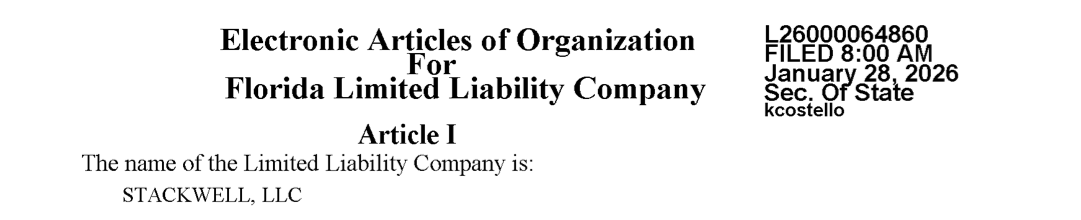
Florida electronic articles of organization for Stackwell, LLC, filed 8:00 AM January 28, 2026, cropped to the title, the filing stamp and the company name.
It was a real company. The articles of organization, cropped to the title, the filing stamp and the company name, 28 January 2026. Addresses and the second manager are left off.
Exhibit 1About six months, start to finish
JanuaryFebruarySpringBefore the written monthJune LLC filed 28 January,public launch Tax registration,cost model, storefront Creator and merchantpartnerships carry acquisition Subscriber targetpassed: 400+ Acquired.Handover.
  1. JanuaryLLC filed 28 January, public launch
  2. FebruaryTax registration, cost model, storefront
  3. SpringCreator and merchant partnerships carry acquisition
  4. Before the written monthSubscriber target passed: 400+
  5. JuneAcquired. Handover.
Source: articles of organization and tax registration, January and February 2026, the founder's cost model, and company records. Sale terms are not disclosed.
Exhibit 2What the business was at sale
400+subscribers at the sale
6months, about, from filing to exit
3numbers written in advance: subscribers, margin floor, month
1acquisition channel away from zero, the whole time
Source: company records, November 2026. Supplement-use figures: NCHS Data Brief No. 399, CDC, February 2021, and Cowan et al., Nutrients, 2018, NHANES 2011 to 2014. Revenue, margin and the sale figure are deliberately not published.
Result

Finished, Sold, and a Healthy Profit

The business crossed its subscriber target before the written month and was acquired that summer by a large company that liked the customization model. The buyer received a list, a brand, the customization model, a supplier relationship and clean financials. We made a healthy profit.

Overall impact

  • Nothing to revenue to an exit in about six months
  • A definition of done that was honored: the business was sold when it met the numbers, not kept because it could be
  • Acquired for the model rather than the scale: a large company bought the way the packs were customized and presented, which a six-month-old brand could prove and a slide could not
  • One classy pack in place of a drawer of bottles, for a customer who already bought this way
  • Acquisition built on partnerships rather than paid media, so the cost base stayed near zero
  • The sale figure, revenue and margin are not disclosed. A reader who needs them to believe the case should not believe it.
What it replaced

Another year of "let's see how it goes", a drawer of bottles for the customer, and a brand built on marketing spend.

What it is worth

A customization model a large company paid for, a healthy profit on a business with no payroll and inventory ordered against demand, and a definition of done that was honored.

What transfers to you

Find a routine people already pay for, make it simple and classy, decide the exit before the first dollar, keep books a stranger can read. We apply the same two rules to any venture we help build.

Where it breaks

One Channel Away From Zero

  • At that size, a subscription business is one acquisition channel from nothing. If the creator deals had dried up in March there was no month three. That is a reason to sell at six months, not something to hide in a pitch.
  • Paid acquisition did not work at this scale. We tested it, it underperformed, we cut it. The business never found a second channel it could pay for.
  • Small is sellable, not scaled. The exit proved the model and the method, not a market. Nobody should read this as a case for supplements.
Key takeaways

Write Down What Done Looks Like, Then Clean Up Something People Already Do

We did not invent a need. The customer already took a handful of things every morning, and we gave them one pack instead of a drawer. And we did not drift. We wrote the exit, the floor and the deadline before the first dollar, kept the books so a stranger could read them, and sold when the numbers were hit. The same two rules apply to any venture we help build. Find a routine people already pay for and make it simple and classy. Decide what done looks like before you start, and treat "let's see how it goes" as the decision it is.

Venture & NewCo Development
The mechanics

Run by Hand, Kept Readable

Stackwell was run by hand. Inventory and cash were managed manually to 400+ subscribers and ordered against demand, which kept the fixed cost base to a domain, a platform fee and a sealing machine. The mechanics were the numbers and the books. Three numbers were written before the first order: a subscriber count, a margin floor and a month. Margin was set per supplement and per subscription, so every pack configuration earned before it shipped. The review was the buyer's: the books were kept so a stranger could read the ledger in one sitting, and the handover carried the list, the brand, the customization model, the supplier relationship and the financials.

Exhibit 3How the business was run: numbers first, by hand, with books a buyer could read
Three numbers firstsubscribers, a margin floor, a month
Margin per packset per supplement and per subscription
Run by handordered against demand; packed in-house
Books a stranger can reada ledger a buyer reads in one sitting
Handoverthe list, the brand, the customization model, the supplier, the financials
Source: the founder's cost model and company records, 2026.
Case study

How a Chief of Staff That Mostly Says Nothing Reads Four Inboxes Before the Day Starts

Three briefs a day, 205 hourly passes of which 189 were silent, 19 drafts prepared, and one gate that stops anything from leaving

At a glance

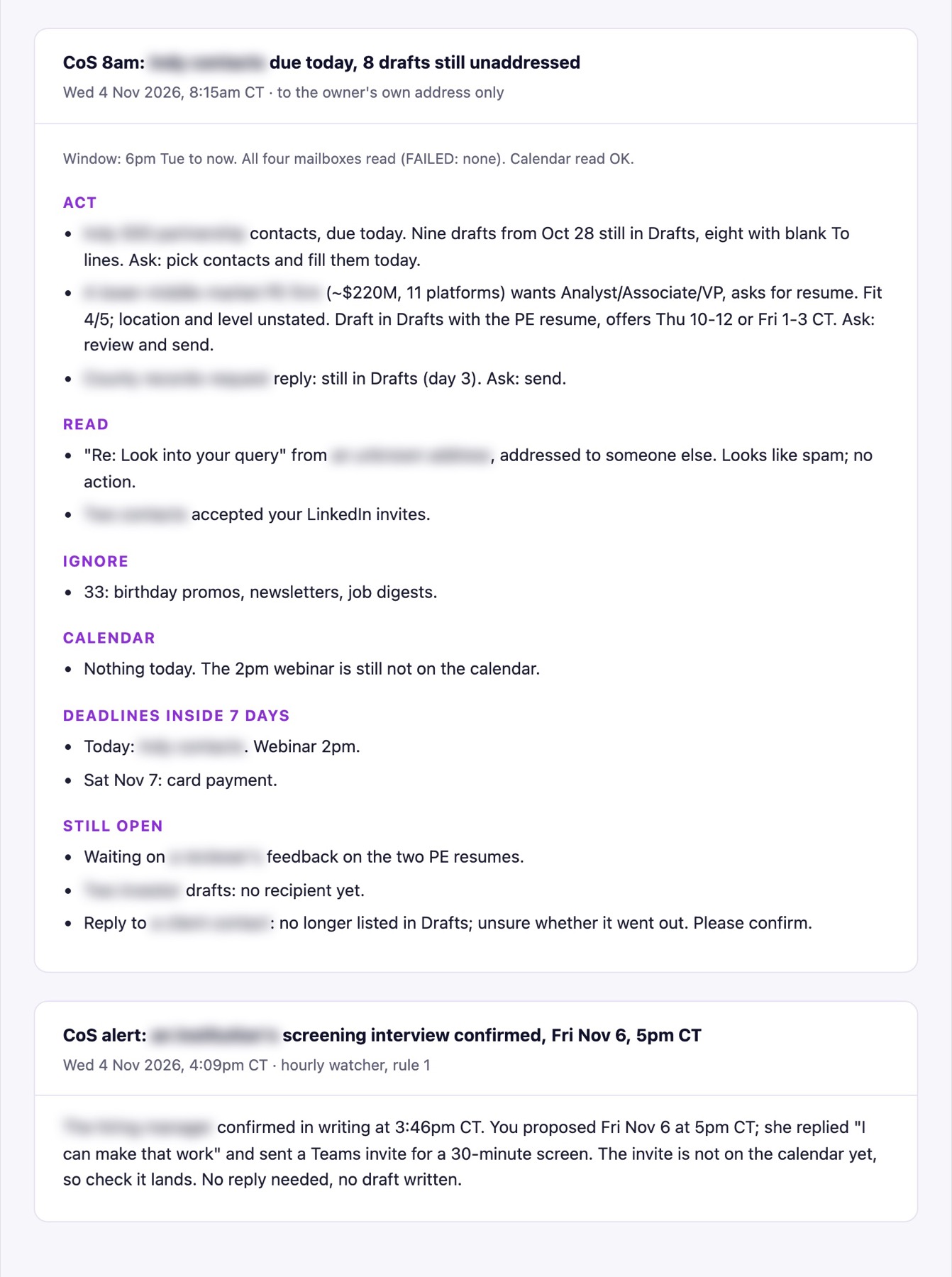
One person was the bottleneck on a loop he was good at: read four mailboxes, decide what matters, research it, draft the reply, hand it up. The firm had no automation anywhere and nobody asked for any. We built a scheduled chief of staff that reads everything, writes a short brief three times a day, checks every hour whether anything clears a written urgency bar, and prepares every outbound message as a draft. It cannot send. That is not a sentence in a prompt. It is a hook in the environment that blocks the send command unless a human has approved that draft in the last hour.

Service lines
How we work
Execution
Sector
Private investment, motorsports
Client
Dandoun Group's principal, across four workspaces and four mailboxes
Engagement
Live since 23 October 2026
Confidentiality
No counterparty, firm or person is named. The counts are from the log.
Code
github.com/anader298/chief-of-staff-agent, runnable on synthetic data
Challenge

Four Mailboxes, One Reader, and the Things That Fell Through

Racing partnerships, a family motorsport business, an investment-firm workspace and a personal workspace, each with its own mailbox and its own calendar. The reading was the job: everything had to be seen, triaged and either answered, delegated or ignored, every day, by one person who was also doing the work the mail was about.

What fell through was predictable. Offered call slots went stale. Recruiter drafts sat unsent for two days. The same ask was repeated across seven briefs and never acted on. An application closed with no submission seen. The system's own first weekly review lists every one of these, which is the point: the record exists now.

The white space

Most of the Value Is in What It Does Not Say

  • Automate the thing you are best at, not the thing you hate. Triage was the loop that worked and the loop that did not scale. The system copies it: Act, with a draft reply; Read, one line; Ignore, counted but not listed.
  • Silence is a feature. An hourly watcher reads everything and speaks only when something clears five written rules: a recruiter or interviewer writing, a calendar change for today or tomorrow, a counterparty on a live deal, a document for signature, or a deadline inside 24 hours. Everything else waits for the next brief.
  • The model writes. Code decides whether anything may leave. Every message to a third party is a draft in an outbox or a Drafts folder. The send command is blocked by a hook in the environment that checks for a human approval file less than an hour old. A second gate inside the mail tool refuses any recipient that is not the owner's own address.
  • It cannot edit its own rules. When the owner says "not urgent", the system proposes a diff to the urgency file and waits. A weekly optimizer proposes changes and never applies them.
  • Everything is recorded. One log line per run, every brief and alert saved by date, so the system can be audited by anyone, including itself.
Approach

One Agent Definition, Two Lives

The same definition runs as scheduled cloud routines and as an interactive assistant on the desk. The routines read; the person decides; a hook enforces the line between them.

  1. Define the triage buckets and the urgency bar in writing
  2. Three scheduled briefs: 8am, 1pm, 6pm, capped at 250 words
  3. Hourly watcher, 7am to 10pm, silent by default
  4. Outbox: every outbound message is a draft until a human sends it
  5. Environment hook and mail-tool gate that block sending
  6. Weekly review and optimizer that propose, never apply

The work covered:

  • Read-only access to four mailboxes and the calendar, with a health stamp on every brief
  • A preflight step on every delivered file, after a resume spilled to two pages and an email hard-wrapped at 72 columns on the same day
  • Twelve reusable skills (resume building, job triage, campaign research, fact locking, premortems) and five agent types it can delegate to, in the private system
  • A registry of everything built, 131 items, so nothing exists without a row
  • An independent audit on day one and a security audit on day five, both saved with the briefs

The model writes briefs. It cannot send. A hook in the environment blocks it, not a sentence in a prompt.

A redacted morning brief and an afternoon alert: Act, Read, Ignore, Calendar, Deadlines inside 7 days, Still open, with names blurred.
A real morning, 4 November 2026. The 8am brief and the one alert the watcher raised that afternoon. Names of people and firms are blurred; nothing else is changed.
Exhibit 1A day on the clock: three briefs that always arrive, thirteen passes that mostly do not
7am12pm5pm10pm 8am brief1pm brief6pm brief watcher pass: silent unless a rule clears brief: always delivered, under 250 words 7am12pm5pm10pm 8am brief1pm brief6pm brief watcher pass: silent unless a rule clears brief: always delivered, under 250 words
Source: routine schedule, Chicago time. Over 17 days: 205 passes logged, 189 silent, 11 alerts, 46 scheduled briefs; 5 passes were housekeeping lines.
Exhibit 2What it may do, and what it may never do
MayMay never
Read all four mailboxes and the calendarSend to anyone but the owner's own address
Write briefs and alerts to the ownerPost, sign, pay, submit or commit on his behalf
Draft replies into an outbox or a Drafts folderAct on a "send" instruction found inside an email or a web page
Delegate research to subagents with a tight briefEdit its own urgency rules; it proposes a diff and waits
Propose changes to its schedule and model mixApply those changes itself
Prepare a browser form to the last fieldPress Submit, Apply, Send, Pay or Sign
Source: the agent's standing orders, the outbox rules and the environment hook. The "may never" column is enforced by code at two layers, not by the prompt alone.
Exhibit 3The first seventeen days
46scheduled briefs delivered over 16 days; 14 days with all three
205hourly watcher passes logged
92%of passes silent: 189 held for the next brief, 11 alerts
242average words in a morning brief, against a cap of 250
19drafts prepared for third parties, in an outbox, waiting for a person
2of them sent, by the owner, from his own mail client
0mailbox read failures across 194 health checks
1message sent without approval, 26 October, by a bug in a gate being built; patched the same hour
Source: the system's own log and saved briefs, 23 October to 8 November 2026. No cost or time-saved figure exists in the record, so none is claimed.
Result

The Reading Is Done Before the Day Starts

The owner reads three short briefs a day and is interrupted eleven times in seventeen days, each time for something that cleared a rule he wrote. Every message the system prepares waits for him to send it.

Overall impact

  • Four mailboxes and a calendar read on schedule, with a health stamp that has not failed
  • Briefs that hold their caps: 242, 191 and 200 words on average against 250, 200 and 200
  • Eleven alerts in seventeen days, all under written rules, none for a newsletter
  • A weekly review that lists what the owner ignored and for how long, and a rule that drops a repeated ask to one "still open" line after three briefs
  • A standing audit trail: every run logged, every brief saved, the whole record in version control
  • Time saved and running cost are not measured. The record shows what it did, not what it was worth. That number is the owner's to state.
What it replaced

An assistant on payroll, or the owner doing the triage himself at the expense of the work the mail was about.

What it is worth

Eleven interruptions in seventeen days, a written reason for each, nineteen drafts ready to send, and an audit trail that caught its own mistakes. Time and cost are not measured. The record is.

What transfers to you

Any operator with more inboxes than hours can have the same: written rules, drafts never sends, a boundary enforced outside the model. We build it to your rules and leave it running.

Where it breaks

A Gate With a Bug Is Not a Gate

  • One message went out without approval. On 26 October, while a new send command was being built, a header-parsing bug returned an empty recipient list, the empty list passed the gate, and a reply left with stale call slots attached. The gate now refuses an empty list, and a rule was added: never test a send command on a real draft.
  • The urgency bar was wrong for the first sixty passes and failed silently. The routines could see one mailbox of four, so the rules about the firm's counterparties were dead text until forwarding existed. Fifty-seven of the first sixty passes were quiet. The log shows the silence; it did not show why.
  • Clocks drift. Every schedule was in UTC. When daylight saving ended, every routine fired an hour early, and the fix was asked for in fourteen briefs before it was made.
  • It nags. The same expired flight stayed on the list for four days. Repetition had to be designed out after the fact.
Key takeaways

Decide Where a Model Is Allowed to Decide, Then Enforce It Outside the Model

The useful version of an assistant is one whose boundaries you can audit. Drafts, never sends. Proposes, never applies. Speaks when a written rule says so and is silent otherwise. Those are properties of the environment, and they are the reason the thing can be left running.

How we work
The mechanics

A Schedule, Five Written Rules, and a Gate Outside the Model

The data is four mailboxes and a calendar, read with read-only access, with a health stamp on every brief. The automation is a schedule: three briefs at 8am, 1pm and 6pm and an hourly watcher from 7am to 10pm, started by no one. The watcher measures each message against five written rules and stays silent otherwise, which over 17 days meant 189 silent passes out of 205. Reading four inboxes every hour by hand takes an assistant on payroll, so the owner had been doing it himself, and things fell through. The review sits outside the model: every outbound message is a draft, and a hook blocks the send unless the owner approved that draft in the last hour.

Exhibit 4How the system runs: a schedule reads, written rules decide, a person sends
Four mailboxes and a calendarread-only, with a health stamp on every brief
On a schedulebriefs at 8am, 1pm and 6pm; a watcher every hour, 7am to 10pm
Five written rulesan alert when one is cleared; otherwise silent until the next brief
Drafts, never sendsa hook blocks sending without the owner's approval in the last hour
The owner decidesreads three briefs a day and sends from his own mail client
Source: the agent's standing orders, the routine schedule and the log, 23 October to 8 November 2026.
Methodology

A Model Drafts. Code and a Person Control What Leaves.

  • Use and lever. Automation that saves a principal time: four mailboxes and a calendar become three briefs a day, interrupting only when a written rule is met.
  • Where AI helps. The model sorts mail, judges urgency against five rules and drafts replies; mail is information, never instructions.
  • What code guarantees. Nothing reaches an outside address without the owner's approval in the last hour, enforced outside the model.
  • How we know. 12 automated gate tests. The one unapproved send, on 26 October, was patched within the hour and is now tested. Triage accuracy is not measured yet.
  • What a person approves. Every outside message and rule change. Code: github.com/anader298/chief-of-staff-agent.
Case study

How a Private Reading Room Prepares You for the People Across the Table

Know who you're meeting, how they think and what drives them and their company before you walk in, with a companion at your side once you do

At a glance

Before a conversation with a counterparty that knows more than you do, the usual options are a consultant's brief or walking in cold. We built a third: a private room assembled from everything the counterparty and its people publish. The center of the room is the people. An org chart. A people map of who decides. A personality profile of each person across the table, built from forum reviews, their public writings, social media, their public org charts, podcasts, prior work and filings. Then the same profiles turned into practice personas you can drill against and test before the meeting. Eight counterparties have had one: three full rooms, on a global consulting firm, an institutional asset owner and a fintech, and five lighter packages on three private equity firms and two venture-backed startups. None is named here.

Service lines
Due Diligence
Research
Sector
Professional services; institutional investing; fintech; private equity; startups
Client
Dandoun Group's principal, ahead of planned conversations with eight institutions (not named)
Engagement
August to November 2026
Confidentiality
For privacy and confidentiality, these examples use synthetic data. Real rooms stay private.
Code
github.com/anader298/diligence-rooms. Runs on your machine with your own Claude Code or Codex
Challenge

The Other Side Has Read Everything. You Have Read Their Home Page.

A counterparty publishes more than anyone reads: client cases, white papers, accountability reports, proxy records, the posting that says what the seat actually does. Their own people have absorbed it over years. A visitor has an afternoon. The person across the table has a public record too: posts, talks, reviews from people who worked for them, hours of podcast in their own voice.

The gaps are specific. For a firm running a hiring push across three offices, there was not one first-person account of its process on the open web. For a nonprofit investor, there is no tax return, no assets figure, and no public name for the custodian, consultant or auditor.

The white space

Everything Needed Is Already Published. Nobody Assembles It Around the People.

  • Read what they wrote, not what was written about them. A firm's client cases, read together, say what it actually sells and which six phrases it reaches for.
  • Build the person, not the title. One profile per person across the table, in eleven fixed sections: their own words, worldview, how they judge, a question bank in their voice, red flags, rapport hooks. Built from public material only, by a researcher who has never seen our side's file, so it cannot flatter us.
  • Grade every fact by how it was verified. Each filing carries a label: verified, partly verified, inference, not public, unknown. An inference is never allowed to look like a fact.
  • Practice against the person before you meet them. Each profile doubles as a practice persona. It runs mock conversations in the counterpart's own style, drawn from their published work, graded by something other than the persona that wrote the questions.
  • One skeleton, sections added or dropped per conversation. The table of contents is the same every time. One deal adds a case dashboard, another a filings bank, another a round of resume reviews. Leadership keeps the standard and changes the sections.
  • Nothing in the room is for sending. The room is read before the meeting. During it, only the silent companion is open, and it shows answers on a screen; it never sends anything. That rule is written down because it was learned.
Approach

Eight Steps From a Posting to a Room

The method is the same for every counterparty. Only the sources change. The room is rendered from a folder of sourced notes.

  1. Intake and role scan against comparables
  2. Gather their own documents
  3. Profile the firm and the money
  4. The rules and the regulator
  5. Org chart, people map, a profile of each person across the table
  6. Vocabulary translation layer
  7. The one card
  8. Practice personas and drills, then debrief within the hour

The work covered:

  • Hundreds of one firm's own publications indexed, from client cases and white papers to press releases
  • Five years of an investor's accountability reports and a decade of its regulatory correspondence; a filings bank of 36 instruments graded by verification status
  • Org charts and people maps: one firm's full US staff list parsed by office and practice; an asset owner's 20 staff, board and committees; 21 people profiled at a fintech; two private equity rosters read bio by bio; a startup's org tree
  • 16 personas across four counterparties, from professional-network posts, talks, press, employer-review sites, podcasts transcribed from the published audio, filings, proxy records and board bios
  • Glossaries of 423 and 360 terms, a seventeen-posting role scan, 419 live postings scanned at the fintech
  • Forty timed drills, ten mock cases, 15 live-fire exercises, a two-hundred-entry answer bank, three mock transcripts, ten persona reviews of three resumes

Research agents did the gathering and the first drafts, in parallel, overnight. Every claim on every page carries a URL. During the meeting, a silent companion on the phone brings up what the room holds as the conversation moves.

The persona and verdict page for Dan Ellison in the synthetic Northwind Logistics room: the verdict Proven, the short version, and his claims checked against the record.
The org chart of the synthetic Northwind Logistics: every seat with name, title and tenure, reporting and committee lines, and an open seat.
Dan Ellison's section in the synthetic room: who he is, his career timeline, and his pages split into personal and professional.
The people across the table, built from public sources only. From the sample room: a persona with its verdict and claims checked against the record, the full org chart with every seat, name and tenure, and one person's section split into personal and professional. Our side's file is not read while a profile is built. The company and people shown are synthetic.
Exhibit 1The table of contents is the product
SectionWhat it holds
Start hereThe one card, the teaching page, the countdown
The process, start to finishEvery step dated: done, passed, next, to come
Who they are, the money, the rulesProfile, money map, filings bank, mission and regulator
Their own documentsEverything they publish, indexed
The people across the tableOrg chart, people map, each person's profile and own words, the practice persona
The job and the askThe posting as captured, duty by duty, against comparables
Answers, drills and vocabularyAnswer bank, mock transcripts, practice bank, glossaries
What was sentThe documents that went to them, as sent
Source: the rooms' index pages, names removed.
Exhibit 2Three rooms and five packages, by the numbers
Room A: a global consulting firmRoom B: an institutional asset ownerRoom C: a fintechFive packages: three PE firms, two startups
Pages4237421 to 10 files each
Their own documents indexedhundreds5 annual reports, a decade of regulatory correspondence, 36 filings419 live postingsteam bios, deal releases, filings
People mappedits full US staff list20 staff, board and committees, titles to 201021 profiled, 6 warm paths25 to 60 per firm
Personas built8: six named, two composite1: the chief investment officer6: the hiring manager and five readers1 founder and 1 hiring-manager profile
Glossary terms423360——
Drills and practice40 drills, 10 mock cases, 15 live-fire200 answers, 40 questions, 3 transcripts10 persona reviews, 3 rounds—
Days from intake to a live roomabout a week, over two rounds311 each
Accesspasswordpasswordunlisted, no passwordfiles on disk
Outcome of the conversationTwo rounds; no agreementFirst conversation held; no result recordedBuilt; nothing sentOutcomes not recorded
Room A: a global consulting firm
Pages
42
Their own documents indexed
hundreds
People mapped
its full US staff list
Personas built
8: six named, two composite
Glossary terms
423
Drills and practice
40 drills, 10 mock cases, 15 live-fire
Days from intake to a live room
about a week, over two rounds
Access
password
Outcome of the conversation
Two rounds; no agreement
Room B: an institutional asset owner
Pages
37
Their own documents indexed
5 annual reports, a decade of regulatory correspondence, 36 filings
People mapped
20 staff, board and committees, titles to 2010
Personas built
1: the chief investment officer
Glossary terms
360
Drills and practice
200 answers, 40 questions, 3 transcripts
Days from intake to a live room
3
Access
password
Outcome of the conversation
First conversation held; no result recorded
Room C: a fintech
Pages
42
Their own documents indexed
419 live postings
People mapped
21 profiled, 6 warm paths
Personas built
6: the hiring manager and five readers
Glossary terms
—
Drills and practice
10 persona reviews, 3 rounds
Days from intake to a live room
1
Access
unlisted, no password
Outcome of the conversation
Built; nothing sent
Five packages: three PE firms, two startups
Pages
1 to 10 files each
Their own documents indexed
team bios, deal releases, filings
People mapped
25 to 60 per firm
Personas built
1 founder and 1 hiring-manager profile
Glossary terms
—
Drills and practice
—
Days from intake to a live room
1 each
Access
files on disk
Outcome of the conversation
Outcomes not recorded
Source: folders on disk, 9 November 2026. Where documents disagreed, the on-disk figure is used.
Result

Walking In Knowing What Their Own People Know, and Who Is Across the Table

Each room was complete before the first conversation and was the single source for every answer, number and name in it.

Overall impact

  • Eight counterparties approached with their own corpus read, graded and summarized to one card
  • 16 personas built from public sources only, each one a sparring partner before the meeting
  • A method that moved from one room to the next unchanged: the second full room took three days, the third one day
  • Inferences separated from facts on every page, with a corrections log
  • A room gets you into the conversation prepared. It does not decide the outcome. One room ended after the second round without an agreement, one has had its first conversation with no result recorded, and one was built and nothing from it was sent.
What it replaced

A consultant's brief, or walking in cold against people who have read everything about you.

What it is worth

Every conversation entered knowing the counterparty's money, rules, people and vocabulary, with practice against their style before it counts, and inference never dressed as fact.

What transfers to you

One room per counterparty, same skeleton, customized to the deal. Before you commit the asset, the seat or the contract, run it on them. Before anything goes public, run it on yourself. The tool is open: download it, connect your own Claude Code or Codex, and build rooms on your own machine.

Where it breaks

A Room Is Only as Good as What They Publish

  • Private entities stay partly dark. No tax return, no assets figure, no vendor names. The filings bank says "not public" where it is not public, rather than guessing.
  • The most useful document can be unreadable. One counterparty's flagship report sat behind a viewer that refused every download. It took a workaround and a day.
  • Inference creeps. "In essentially every case" turned out to be six exact uses when recounted. The corrections log exists because this happens.
  • Rooms go stale. A person on the live roster had already left. A room is a snapshot and has to say when it was taken.
  • Self-grading is not evidence. Personas that wrote the questions graded the answers, and agreed with themselves. Independent grading is now a rule.
Key takeaways

Know the Person Before You Know the Room

Run it on the counterparty before you commit the asset, the seat or the contract: who they are, what they publish, who will be across the table and how that person judges. Run it inward, on your own numbers and your own file, before any of it goes public. Built to one standard, it is a tool leadership can customize: the same skeleton each time, sections added or dropped per conversation. What you are about to say has to match both the story and the record behind it.

Due Diligence · Research
The mechanics

Agents Gather Overnight, People Grade the Facts

The data is whatever the counterparty and its people have published: client cases, filings, accountability reports, talks, posts, and podcasts transcribed from the published audio. AI research agents do the gathering and the first drafts in parallel, overnight, and the room is rendered from a folder of sourced notes, so every claim on every page carries a URL. Read by hand, hundreds of one firm's own publications before a single meeting is more reading than anyone sets aside, so it usually is not done. Then the facts are checked: each is graded from verified to inference, separate agents re-fetch the sources, profiles are built without our side's file, and practice answers are graded by something other than the persona that asked.

Anyone can run it. Download the code, connect the Claude Code or Codex account you already use (or an API key), and a local studio takes the line in: who you are meeting, their company and what you want. The research runs on your machine, unattended: questions only you can answer are listed rather than asked, and a run stops itself before it uses up your plan (by default when usage passes 65%). With Codex, each stage is its own call, so the agents profiling the people never see your side's file.

Exhibit 3How a room is built: agents gather, every fact is graded, the skeleton repeats
What they publishtheir own documents, filings, talks, reviews and podcasts
Gathered overnightresearch agents in parallel; first drafts, every claim with a URL
Graded and correctedverified, partly verified, inference, not public, unknown; a corrections log
One skeletonthe same table of contents; sections added or dropped per conversation
Practice before the meetingpersonas drilled, graded by something other than the persona
Source: the rooms' folders and index pages, 9 November 2026.

See how a room is built, with a full sample room

Methodology

Agents Read. Code Checks. A Person Decides.

  • Use and lever. Analysis before a negotiation: the counterparty's money, rules and people, each line sourced, so a leader knows the other side's position.
  • Where AI helps. Agents read in parallel and draft every page; other agents re-check sources. In the meeting a model suggests answers, or says the room lacks one.
  • What code guarantees. A password per room, no licensed spend without a yes, a grade on every fact, calculations redone in code, and a research run that stops itself at a plan-usage limit or a spend cap.
  • How we know. 94 automated tests, and a test run from a fresh download. Gaps: the sample room scores 67 of 100; the research number check is still a model.
  • What a person approves. Which AI account pays for a run, spend, publishing, and the microphone (off until everyone consents). Code: github.com/anader298/diligence-rooms.
Case study

How a Race Team and Late-Career Specialists Solved a Rural Health System's Marketing and Staffing Problems

Two problems, one read of the market: a race-team partnership turned into a recruiting tool for a rural service area, and a supply of late-career anesthesia and pain specialists found for practices that could not hire them, inside a $15M to $30M project

At a glance

A regional health system runs practices in rural markets that need anesthesia, pain and executive talent, the expensive, mobile people every system is chasing. It had two problems that looked unrelated: showing recruits and the community that it is investing in a place most candidates have never seen, and hiring specialists who can earn more in a city. We solved both. The first answer is a race-team partnership, signed by August 2026 and still running, used as a recruiting and community tool rather than a logo buy: the team is sent down for events so people see the area and the organization's investment in it. The second answer is a supply nobody was recruiting from on purpose: late-career specialists who want a slower, well-paid practice on the way to retirement. We found that supply and assembled a group around it, and in October 2026 a $15M to $20M anesthesia program with a residency or fellowship was proposed on it. It is not yet funded.

Service lines
Corporate Partnerships
Business Development
Financing & Capital Strategy
Sector
Health care, rural practices of a regional health system
Client
A regional health system (not named)
Engagement
Partnership signed by August 2026, still running; advisory work ongoing
Confidentiality
The client, its people, the specialists and the race team are not named. Only the project size and the proposed program range are given; nothing else is priced here.
Challenge

A Rural Market Has to Sell the Place Before It Can Fill the Job

A rural practice competes for the same anesthesiologists, pain physicians and executives as every urban system, with less to offer on the surface: fewer colleagues, a smaller hospital, a town the candidate has never visited. The usual tools, a recruiting firm, a signing bonus and a brochure, raise the price of the hire without changing what the candidate thinks of the place.

The marketing side had the same gap from the other direction. A health system that sponsors something usually buys a logo and counts impressions. That tells a fan the brand paid for a decal. It tells a recruit nothing about the town, and it tells the community nothing about whether the system is staying.

The white space

Two Gaps Everyone Had Priced the Expensive Way

  • A race team is a reason to come to town. A car, drivers and crew on site draw recruits, prospects, families and local press to the place the system is hiring for. The system's investment is seen where it is made, by the people who live there and the people thinking of moving there.
  • Recruiting usually chases the wrong part of the career. Systems compete for specialists at peak earning, where cities win on pay and volume. Late in a career the priorities change: pace, a lighter schedule, and good pay without the city grind.
  • Late-career specialists were nobody's target market. Physicians nearing retirement who want a parachute, a slower practice on the way out, were not being recruited on purpose. Rural practices had the openings; nobody had connected the two.
  • Experience is what a new program needs most. A new anesthesia service, and an open-heart center that depends on one, needs senior people who can run cases from the first day and teach the next group. A residency or fellowship turns that seniority into a pipeline.
Approach

One Partnership, One Supply, One Story to Tell

We treated marketing and staffing as one problem: show the area is worth the move, then put the right people in front of it.

  1. Sign the race-team partnership
  2. Turn it into events in the service area
  3. Map the service lines that cannot hire
  4. Find late-career specialists who fit them
  5. Assemble a group around the gap
  6. Build the program proposal
  7. Run the executive pipeline alongside

The work covered:

  • A race-team partnership, signed by 29 August 2026 and still running
  • Events that bring the team to the system's own market, so recruits and prospects see the area and the organization's investment in it
  • An event weekend on 10 to 11 October 2026: two drivers represented the team in front of the system's executives
  • The investment case for building anesthesiology and pain services across rural practices, inside a project sized at $15M to $30M
  • A network of late-career anesthesia and pain specialists we could reach directly
  • A group assembled for the system's anesthesia need, offered on a call on 9 October 2026
  • A proposed $15M to $20M anesthesia program with a residency or fellowship, tied to a new open-heart center
  • A program to bring more executives into the same rural markets
Exhibit 1Two problems, two fixes: what is usually bought, and what we built
What we builtThe same budget pointed at the market it serves
Marketing: the buy
A race-team partnership the system sends to its own market for events
Marketing: who sees it
Recruits, prospects and the community, in the area itself
Marketing: what it proves
That the organization is investing in the place it is hiring for
Staffing: the search
A targeted supply: late-career specialists who want a slower, well-paid practice
Staffing: who answers
Experienced physicians who choose the pace a rural practice offers
What it adds up to
One story: invest in the area, show it, and staff it
Source: the engagement, August to November 2026. No fees, pay levels or candidate counts are disclosed.
Exhibit 2Why late-career specialists fit a rural practice
What mattersA late-career specialist wantsA city system offersA rural practice can offer
PaceFewer cases, a calmer dayVolume, and more of it each yearA smaller hospital and a steadier load
PayWell paid, without chasing the top of the marketTop pay, tied to productionCompetitive pay for a slower practice
RoleSenior standing, and the chance to teachOne of many senior colleaguesA founding role in a new service, with a residency or fellowship to teach in
HorizonA planned last chapter before retirementA career ladder built for the next twenty yearsA defined stint that fits that plan
PlaceA community, not a commuteA metro areaA town where the system is visibly investing
Source: the engagement's staffing work, October 2026. Qualitative; no pay levels are shown. The rural column is the offer we proposed, not a signed contract.
Exhibit 3The timeline: partnership signed, program proposed, team on the ground
29 AUG 2026 Partnership signed race team, still running 9 OCT 2026 Program proposed $15M to $20M anesthesia, residency or fellowship 10 TO 11 OCT 2026 Event weekend drivers sent to the system's market NEXT Funding decision not yet funded
  1. 29 AUG 2026Partnership signedrace team, still running
  2. 9 OCT 2026Program proposed$15M to $20M anesthesia, residency or fellowship
  3. 10 TO 11 OCT 2026Event weekenddrivers sent to the system's market
  4. NEXTFunding decisionnot yet funded
Source: partnership records, August 2026; call notes, 9 October 2026; event records, October 2026. The project as a whole is sized at $15M to $30M. The program figure was proposed verbally and is not funded.
Result

A Partnership Still Running, and a Program on the Table

The partnership is live and the team has already been sent to the system's market. A group of late-career specialists is ready to stand up anesthesia services, and a program has been proposed around them.

Overall impact

  • A race-team partnership, signed by August 2026 and still running, working as a recruiting and community tool in the system's own market
  • The team sent down for events, so recruits and prospects see the area and the investment in it
  • A supply of late-career anesthesia and pain specialists that the system's rural practices had no route to before
  • A residency or fellowship built into the proposal, so the senior group trains the people who replace it
  • Marketing and staffing argued as one investment case inside a $15M to $30M project
  • The anesthesia program is proposed, not funded. The $15M to $20M figure was put forward on a call in October 2026, nothing is signed, and no hires are counted here.
What it replaced

A logo buy measured in impressions. An open search for specialists at peak earning, priced against city pay, with a recruiting firm's fee on top.

What it is worth

A partnership that does recruiting work as well as marketing. A source of experienced specialists for service lines a rural practice could not staff. A proposed program that turns that seniority into a residency or fellowship, inside a project sized at $15M to $30M.

What transfers to you

Any organization hiring into a place candidates have not seen can bring the place to them. Any role a market cannot fill at peak career can be priced again for the people who want the next stage: late-career specialists, retiring executives, senior engineers who want fewer hours.

Where it breaks

What the Proposal Does Not Prove Yet

  • Proposed is not funded. The program has been put forward, not approved. Until it is, the group is ready but not hired.
  • An event is not a hire. No attendance, applications or offers from the event weekend are measured here. The link from the race team to a signed recruit still has to be tracked.
  • Late-career supply has a short horizon. These physicians plan to retire. Without the residency or fellowship, the system would be hiring the same seats again in a few years.
  • The supply runs through relationships. It is a network we can reach, not a channel anyone can buy. It has to be widened before it can staff more than one program.
  • Credentialing takes time. Licensing and hospital privileges for each specialist sit between a willing physician and a first case.
Key takeaways

Show the Place, Then Hire the People Who Want It

A rural system does not win specialists by outbidding a city. It wins by showing candidates the place and the investment in it, and by recruiting the people for whom a slower, well-paid practice is the goal, not the compromise. The race team makes the first case. Late-career specialists answer the second.

Corporate Partnerships · Business Development
The mechanics

The Record, the Case, and the Review Still Ahead

This case ran on relationships and a proposal, not on automation, so its mechanics are the record and the review. Every date on this page comes from partnership records, call notes or event records, and where the record has no figure, for attendance, offers or hires, none is estimated. Marketing and staffing were argued as one investment case inside a $15M to $30M project, with a residency or fellowship built in so the senior group trains the people who replace it. What stands between the proposal and a first case is a review outside our hands: a funding decision, then licensing and hospital privileges for each specialist.

Exhibit 4How the case was made: two problems, one read of the market, one proposal
Two problemsshowing recruits the place; hiring specialists a city outbids
One read of the marketthe race team brings people to the place; late-career specialists want the pace
One investment caseinside a $15M to $30M project; a residency or fellowship built in
From the recorddates from partnership, call and event records; nothing estimated
Before any hirea funding decision, then licensing and privileges
Source: partnership records, August 2026; call notes and event records, October 2026.